Gulzar Poetry Kuch Aur Manzar – 1 in Hindi & English with Meaning (English Translation) | गुलज़ार – कुछ और मंजर-1


Hindi Kala presents Gulzar Poetry Kuch Aur Manzar – 1 about summers in Hindi & English with the poem’s Meaning (English Translation).

गुलज़ार की कविता कुछ और मंजर-1
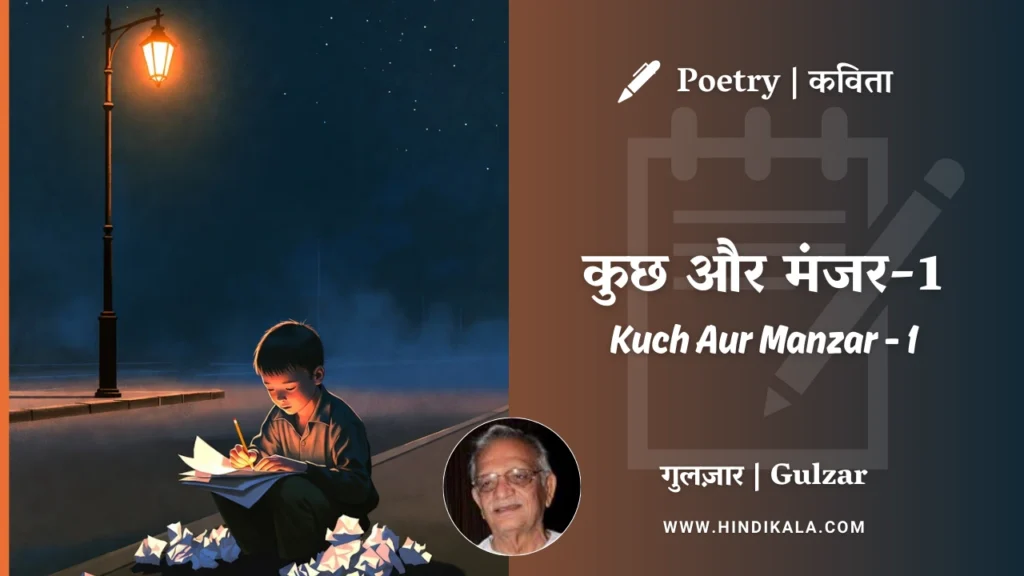
कभी कभी लैम्प पोस्ट के नीचे कोई लड़का
दबा के पैन्सिल को उंगलियों में
मुड़े-तुड़े काग़ज़ों को घुटनों पे रख के
लिखता हुआ नज़र आता है कहीं तो..
ख़याल होता है, गोर्की है!
पजामे उचके ये लड़के जिनके घरों में बिजली नहीं लगी है
जो म्यूनिसपैल्टी के पार्क में बैठ कर पढ़ा करते हैं किताबें
डिकेन्स के और हार्डी के नॉवेल से गिर पड़े हैं…
या प्रेमचन्द की कहानियों का वर्क है कोई, चिपक गया है
समय पलटता नहीं वहां से
कहानी आगे बढ़ती नहीं है… और कहानी रुकी हुई है।
ये गर्मियाँ कितनी फीकी होती हैं – बेस्वादी।
हथेली पे लेके दिन की फक्की
मैं फाँक लेता हूं…और निगलता हूं रात के ठन्डे घूंट पीकर
ये सूखा सत्तू हलक से नीचे नहीं उतरता
ये खुश्क़ दिन एक गर्मियों का
जस भरी रात गर्मियों की
Gulzar Poetry Kuch Aur Manzar in Roman Transcript with Meaning (English Translation)
Kabhi Kabhi Lamp Post Ke Neeche Koi Ladka
Daba Ke Pencil Ko Ungliyon Mein
Mude-Tude Kaagazon Ko Ghutnon Pe Rakh Ke
Likhta Hua Nazar Aata Hai Kahin To..
Khayal Hota Hai, Gorky Hai!
Pajame Uchke Ye Ladke Jinke Gharon Mein Bijli Nahin Lagi Hai
Jo Municipality Ke Park Mein Baith Kar Padha Karte Hain Kitaaben
Dickens Ke Aur Hardy Ke Novel Se Gir Pade Hain…
Ya Premchand Ki Kahaniyon Ka Work Hai Koi, Chipak Gaya Hai
Samay Palatta Nahin Wahan Se
Kahani Aage Badhti Nahin Hai… Aur Kahani Ruki Hui Hai.
(Sometimes, beneath a lone lamppost,
A boy is seen—pencil clenched in fingers,
Crumpled pages balanced on knees,
Writing… and for a moment, you think—it’s Gorky.
These boys with hiked-up pajamas, from homes without power,
Reading by moonlight in the public parks,
Have tumbled out of Dickens’ or Hardy’s old tales…
Or perhaps, a torn page of Premchand’s story
Clings to time that refuses to move—
The plot stands still, paused in mid-thought, frozen.)
Yeh Garmiyan Kitni Feeki Hoti Hain – Beswaadi.
Hatheli Pe Leke Din Ki Fakki
Main Faank Leta Hoon…Aur Nigalta Hoon Raat Ke Thande Ghunt Peekar
Ye Sukha Sattu Halak Se Neeche Nahin Utarta
(These summers—they feel so bland, tasteless.
Palming the dry pill of each day,
I gulp it down, chasing it with cold swigs of night.
But the dry sattoo won’t go down my throat—)
Yeh Khushk Din Ek Garmiyon Ka
Jas Bhari Raat Garmiyon Ki
(These parched days of summer,
And the heavy nights that follow.)
Essence of the Poem
The poem juxtaposes the resilience of those enduring poverty with the speaker’s own emotional detachment, framing summer as a stark, lifeless backdrop to these contrasting experiences.
Key Themes:
Poverty and Perseverance:
The boy studying under a lamppost symbolizes determination despite hardship. References to writers like Gorky, Dickens, Hardy, and Premchand reflect a longing for knowledge and a deeper understanding of human struggle.
Stagnation and Futility:
Lines like “time doesn’t turn back from there” and “the story is stuck” evoke a sense of entrapment, where progress feels unattainable.
The Speaker’s Disconnection:
Describing summer as “bland” and “tasteless” reveals a numbing apathy. The metaphor of consuming the day like “dry powder” and washing it down with “cold draughts of night” underscores a hollow, mechanical existence.
Sharp Contrasts:
The poem highlights the divide between the marginalized, who cling to hope, and the speaker, who feels nothing but emptiness—a commentary on how stagnation manifests differently across lives.
Interpretation:
The opening stanza portrays resilience amid adversity. The boy under the lamppost, immersed in literature, becomes a symbol of defiance against his circumstances, linking his plight to broader narratives of struggle.
In contrast, the second stanza shifts inward, exposing the speaker’s disengagement. Summer, typically vibrant, feels inert—mirroring their emotional void. The act of mechanically “consuming” time suggests a life devoid of meaning.
The closing lines—a detached observation of day and night—reinforce the speaker’s alienation, leaving the reader to reflect on the poem’s central tension: the tenacity of the oppressed versus the numbness of the disaffected.
Final Thoughts:
This poem is a quiet yet piercing exploration of inequality, contrasting the unyielding spirit of the marginalized with the jaded weariness of those who, despite relative privilege, find life barren. The juxtaposition asks: What does it mean to endure, and what does it mean to simply exist?
You Might Also Like
- Gulzar Triveni Poems in Hindi & English with Meaning (English Translation) | गुलज़ार – त्रिवेणियाँ

- Gulzar Poem Hindustan Mein Do Do Hindustan Dikhai Dete Hain in Hindi & English with Meaning (English Translation) | गुलज़ार – हिंदुस्तान में दो दो हिंदुस्तान दिखाई देते हैं
- Gulzar Poem Har Baat Pe Hairaan Hai Moorakh Hai Ye Naadaan Hai in Hindi & English with Meaning (English Translation) | गुलज़ार – हर बात पे हैरां है मूरख है ये नादां है
- Gulzar Poem Humein Pedon Ki Poshaakon Se in Hindi & English with Meaning (English Translation) | गुलज़ार – हमें पेड़ों की पोशाकों से
- Gulzar Poem Humdum in Hindi & English with Meaning (English Translation) | गुलज़ार – हमदम

Tags: